Archive for the ‘Gardening’ Category

Hopi Orange, Well, etc.

21 May 2009

Twelve Hopi Orange Winter squash came up a couple of days ago (out of 16 seeds planted), and are looking big and vigorous.

IMG_0512

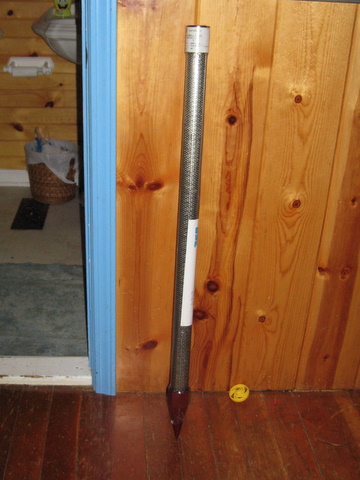
Also, received my 1¼” sandpoint from Lehman’s today, all ready for me to drive my new well next week, which I’m taking off. Also got the couplings and drive cap, so all I need to drive the well is the pipe, which I’ll get locally. I’ll worry about the pump later. The water table is definitely less than 20′ down here — sometimes it’s only about 3′.
IMG_0513

Also, the dehumidifer in the basement started running this week, and will probably run constantly for the next 5 months. Late last summer, I turned the humidistat up to 60%, so it’s running less than it used to. And the catbird in the back yard returned and started singing this week, so…when the dehumidifier starts running and the catbird starts singing, it’s safe to plant tomatoes.
Are you kidding? Why?

20 May 2009

So yesterday I put out containers for collecting used coffee grounds at a couple of the coffee-brewing stations in the building where I work. On the containers, I wrote, “Please recycle coffee grounds here.”

Today, a note was attached to one of them that said:

“Are you kidding? Why?”

Now I don’t know who wrote that, so I don’t know anything about who they are. But it just hit me as an indication of how disconnected some of us are from the cycles of growth and decomposition that keep us alive. A gardener sees dead organic matter and thinks, “I could compost that and turn it into something that would really help the plants in my garden grow.” A non-gardener sees dead organic matter and thinks, “Filth. Dispose of it.”

Many of us still believe that when food we were eating a few moments before hits the garbage can, it becomes something disgusting that must be put in a plastic bag and sent to the landfill. Many of us still try as hard as we can to believe that death and decomposition do not exist, when they are just as essential to life as are birth and growth. I think that, at least in part, explains the problem people have with treating dead organic matter as a resource instead of garbage to be disposed of.

Anyway, I taped a reply to the outside of the container:

Why Recycle Coffee Grounds?

  • One less thing to go the landfill
  • They can be used to feed plants which can feed people.
    For more info, including a chemical analysis, see http://www.starbucks.com/aboutus/compost.asp

    • Added directly to soil
    • Composted
    • Fed to worms

Efficiency

19 May 2009

Fertilized all the tomatoes and peppers in the garden with fish emulsion. Tomatoes are looking pretty tattered — many of them have frost damage, and most have some leaves that are dry and yellowing. We’re having some warm weather now, so I expect them to perk up in the next few days.

Cut more long grass with the grass whip, raked it up, and laid it down between plants in garden. It’s pretty easy to make hay that way, but I’m sure doing a big field would be a huge pain. Still, we’ve got to figure out how to do things without using external fuel sources, so even if cutting hay by hand is slow it’s a good thing.

I was going to say cutting hay by hand was “inefficient” when I really meant slow. It’s not inefficient to do something without our fossil fuel slaves, it’s actually more efficient when you look at the total cost of using ancient sunlight.

Garden update

18 May 2009

Fertilized onion sets with fish emulsion this evening. They continue to look good.

Cut some long, coarse grass around the edges of the yard with the weed whip and used it as mulch around the tomatoes. Also mowed some of the lawn with the unpowered mower and raked up some clippings from that.

I did not mulch closely, since the soil needs to warm up more. Mulching will help conserve moisture and make a good home for beneficial soil flora and fauna.  The grass has not seeded yet, it’s just leaves at this point, so I should not be adding weeds to the garden. Add organic matter to your soil, add organic matter to your soil, add organic matter to your soil.

And speaking of organic matter, today I began collecting coffee grounds from various coffee-brewing stations around my workplace. Might as well bring them home and compost them, or feed them to the worms, or dig them directly into the soil, rather than send them to the county landfill. They are a seed meal, after all, and contain significant nitrogen.

Last Frost?

17 May 2009

We had a frost last night, we’re hoping it’s the last of the season. It’s been a harsh weather week for the plants recently set out — lots of wind and hard rain, a strong, dry wind all day yesterday, and then a frost.

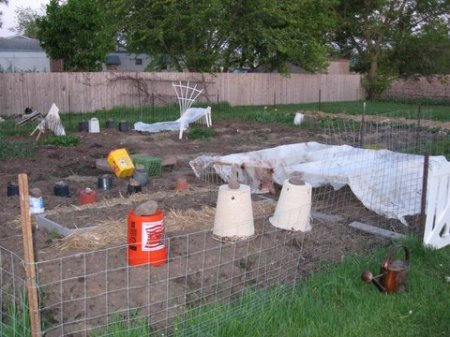
Here’s the garden all bundled up last night:

IMG_0483

Unfortunately, that wasn’t enough. It was approximately 30°F before the sun came up. I uncovered everything a little after 9am. The tomato under the orange bucket in the foreground had some frost damage where it was touching the inside of the bucket, and some under the white dropcloths were damaged as well. We did not cover the potatoes at all (for some reason I thought they wouldn’t be bothered by some frost, and there are a lot to cover), and they took a lot of damage. They’re not going to die or anything, but they’ll definitely be set back. It’s kind of a bummer, but I understand that we’ve been pushing the dates a bit.

And yet they say that potatoes can be planted a month before the last frost. Maybe getting frosted doesn’t hurt them much, and it’s worth it to get started on the underground structure of the plant? I’ll have to look into that.

The onion sets are looking good. They were uncovered last night and don’t seem affected. Need to get some fish emulsion on them.